
The need for closure explains why people take a wrong answer over no answer. Psychologist George Loewenstein described the pull in 1994. He called it a deprivation that a noticed gap in knowledge sets off (Source: CMU).
Brains register it too. A 2009 study recorded 47 midbrain dopamine neurons in monkeys. The same cells that tracked expected water also tracked the promise of early news (Source: PMC).
People pay for it in pain. In a 2016 study, students facing uncertain shock pens clicked about five pens. Students who knew the outcome clicked about one safe pen and two shock pens (Source: Neuroscience News).
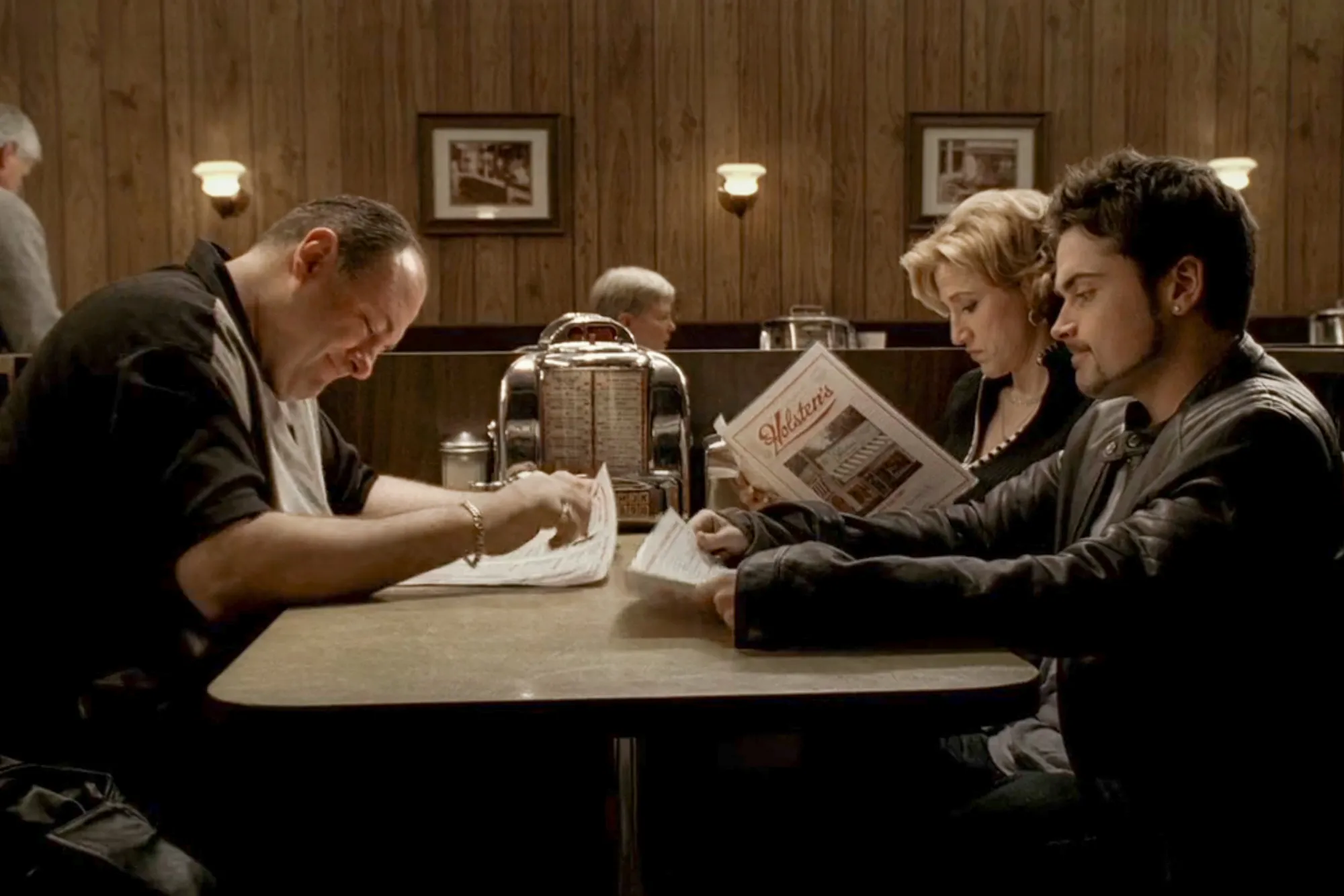
Television tested it at scale. About 11.9 million viewers watched The Sopranos cut to black on June 10, 2007 (Source: Next TV).
In 2026, 19 years later, fans still argue over whether Tony died (Source: Slash Film).
On June 10, 2007, about 11.9 million people sat down to watch the last episode of The Sopranos. For eight years, the show followed New Jersey mob boss Tony Soprano, a man who spent an unusual amount of screen time on his therapist’s couch. By the finale, most of his crew had died or gone to prison. Nearly everyone around him had paid for what they’d done.
Tony hadn’t. Not yet.
The last scene takes place in a diner. Tony slides into a booth and picks a Journey song on the tabletop jukebox. His wife arrives, then his son. A man in a Members Only jacket walks past and heads to the restroom. Outside, his daughter keeps fumbling a parallel park. The door chimes ring, and Tony looks up.
Then the screen cuts to black. No music. No sound. For about ten seconds, nothing happens, then the credits roll in silence.
The Night Everyone Thought the Cable Died
Quick Summary: David Chase ended “Made in America” with a silent, empty frame. Plenty of households blamed their cable boxes (Source: Hollywood Reporter). Fans then spent years rebuilding Holsten’s diner shot by shot, tracking the Members Only jacket and every door chime.
Plenty of viewers thought their cable had cut out. Once they realized the show had ended that way on purpose, the arguments started.
Creator David Chase refused to explain the ending for years, so the fans explained it for him. They went back through the episode frame by frame. They tracked the man in the jacket, counted the door chimes, and tied the final scene to lines from earlier seasons. One fan blog posted an exhaustive shot-by-shot breakdown arguing that Tony dies the moment the screen goes black. Other fans swear he lives.
The funny part? Tony Soprano never existed. People still spent years trying to settle a question a writer left open on purpose.
What George Loewenstein Called the Information Gap
Quick Summary: A Carnegie Mellon economist framed wanting-to-know as hunger. Noticing the distance between known and wanted facts creates discomfort. Gaps that feel close to closing pull hardest, so one half-remembered trivia answer can sour a whole night out (Source: CMU).
The Sopranos makes an easy case for a simple claim. People want closure. When a question stays open, they tend to close it.
Sometimes they close it in their heads, with a theory, even when they lack the facts. Other times they close it in the world, by doing something. Both start with the same itch for closure and, most of the time, for certainty.
In 1994, psychologist and economist George Loewenstein called this the information-gap theory. When people notice a gap between what they know and what they want to know, they feel deprived. Loewenstein compared it to hunger. Something feels missing, so the mind goes looking to fill it.
He also noticed that small gaps pull harder than big ones. You know the feeling. The answer sits on the tip of your tongue and won’t come out. Blank on one at bar trivia, and it can ruin the rest of your night.
Why the Sopranos Ending Still Itches
Quick Summary: Holsten’s shrinks the question to one detail. Chase cut away before that detail arrived. In The Sopranos Sessions, Chase himself slipped, calling the ending a “death scene,” then walked it back (Source: Fox News).
The final scene runs on that same pull. By the end, a whole season of questions narrows to one sequence. Does Tony die?
Every shot in the diner shrinks the gap a little more. The man in the jacket walks by. The door chimes. The daughter circles the curb. Everything moves around Tony, and viewers feel one detail away from the answer. Then Chase cut the scene before the last detail arrived.
Chase felt the pull too. In The Sopranos Sessions, a 2019 book by TV critics Matt Zoller Seitz and Alan Sepinwall, he talked about how long he’d carried the ending around. “I think I had that death scene around two years before the end,” he said. The authors pointed out what he’d just called it. Chase paused, then swore at them.
He’d spent nearly 12 years refusing to answer. The itch still almost got him.
The Zeigarnik Effect and the Waiter Who Forgot
Quick Summary: Bluma Zeigarnik began studying unfinished tasks after Kurt Lewin noticed a waiter remembering unpaid orders. Her 1927 paper claimed interrupted tasks stick in memory. A 2025 meta-analysis found that memory is unreliable, but people consistently return to interrupted tasks when given the chance.
In the 1920s, psychologist Kurt Lewin noticed something about a waiter. The man could recall unpaid orders in full detail. Once the customers paid, he couldn’t remember the orders at all.
Lewin’s student Bluma Zeigarnik turned that into an experiment. She gave people simple tasks, like puzzles, and interrupted some of them partway through. In her 1927 paper, people remembered the interrupted tasks better than the ones they’d finished. The finding took her name, and software companies still borrow it to pull new users through setup.
Here’s the catch. Later researchers struggled to replicate the memory effect. In 2025, Romain Ghibellini and Beat Meier pooled decades of these experiments into one meta-analysis. They found no reliable memory advantage for unfinished tasks. Something else held up instead, and it came from Zeigarnik’s colleague Maria Ovsiankina. When given the chance, people return to an interrupted task and try to finish it.
The Sopranos fans fit Ovsiankina’s theory better than Zeigarnik’s. Chase interrupted the scene, and the fans went back in. They replayed the diner, counted the chimes, and tried to finish the episode themselves.
The Monkeys Who Wanted to Know Early
Quick Summary: Ethan Bromberg-Martin and Okihide Hikosaka offered macaques a choice of targets. One target revealed the size of the coming water reward right away. The macaques preferred it, even though knowing early never got them extra water (Source: PMC).
Only an answer scratches that itch. And the answer doesn’t even have to help.
In 2009, neuroscientists Ethan Bromberg-Martin and Okihide Hikosaka tested this with monkeys. Each monkey chose between two targets on a screen. A few seconds later, it got either a big sip of water or a small one, at random.
The twist came in the targets. Pick one, and a cue appeared right away, showing which reward was coming. Pick the other, and the monkey learned nothing until the water showed up. Either way, the reward stayed random.
The monkeys strongly preferred the target that told them early. Knowing sooner didn’t change what they got. It only changed when they found out. Still, the same dopamine neurons that respond to rewards also responded to the promise of early news. To the monkey’s brain, the information paid out a lot like the water did.
The Pandora Effect and the Shocking Pens
Quick Summary: Christopher Hsee and Bowen Ruan named the Pandora effect after the myth of the forbidden jar. Uncertain pens drew more clicks than pens labeled “shocking.” Predicting feelings beforehand cut clicking and raised happiness (Source: Chicago Booth).
People do the same thing, sometimes at their own expense. In 2016, Christopher Hsee and Bowen Ruan ran a set of studies they named the Pandora effect. The name comes from the myth of the woman who opened the jar she’d been told to keep closed.
Participants thought they’d come in for a different study. While they waited, they found a table of prank pens. The researchers said pens with red stickers would deliver a mild shock when clicked. Pens with green stickers wouldn’t. Pens with yellow stickers might or might not.
People clicked the yellow pens far more than the red ones. When they knew a pen would shock them, they mostly left it alone. When they didn’t know, they clicked to find out, even if that meant getting zapped.
The researchers swapped in other unpleasant outcomes, including grating sounds like nails on a chalkboard. The pattern held. Not knowing pulled people toward things they’d have avoided if they had known.
In one version, the researchers asked people to predict how they’d feel after clicking. Those people clicked less, and they reported feeling happier afterward. Stopping to picture the outcome took a little of the itch away.
Arie Kruglanski and the Need for Cognitive Closure
Quick Summary: Psychologist Arie Kruglanski defined the need for closure as a desire for definite knowledge on some question. Under time pressure, people seize on early information and freeze on the judgment it suggests. Kruglanski and Donna Webster traced that pull into stereotyping, persuasion, and group decisions.
Loewenstein explained why a gap pulls at us. Arie Kruglanski studied what happens after we grab something to fill it.
In 1996, Kruglanski and Donna Webster published a paper in Psychological Review called “Motivated Closing of the Mind.” They defined the need for closure as a desire for definite knowledge on some issue. One word in their framing sits in parentheses. They called it the need for nonspecific closure. Any firm answer will do, and accuracy never enters into it.
They described two moves. First, people seize. They grab the earliest information on hand, and they grab it fast. Then they freeze. Once they’ve settled on an answer, they stop letting in information that might unsettle it. Time pressure makes the seizing worse.
Kruglanski and Webster tracked the effects through first impressions, stereotyping, persuasion, and group decisions. That list reads like a week of meetings.
A Wrong Answer Closes the Gap Just as Well
Quick Summary: A supervisor’s unanswerable question shows the same mechanism at work. A made-up reply would have ended her discomfort as fast as a true one. The Sopranos fans followed the same script and filled Chase’s silence with their own verdicts.
We want answers. I’ve lived this one at work.
A supervisor once asked me a question nobody on the team could answer. I could have told her, “We can’t know.” But I knew a made-up answer would satisfy her more than the truth would. In our world, a wrong answer beat no answer.
Looking back, that meeting worked a lot like the yellow pens. My answer wouldn’t have changed the work needed to find the real one. It would only have closed the gap between her question and the blank she felt. A wrong answer would have closed it just as well as a right one.
The Sopranos fans did the same thing. Chase never gave them an answer, so they filled in the blank themselves. None of them needed the right answer. They needed an answer that let the question rest.
How to Handle Uncertainty at Work Without Inventing an Answer
Quick Summary: Handling uncertainty at work starts before you answer. Predict how the answer will make you feel, as Hsee and Ruan’s pen study suggests. Give your odds in numbers, the way Sherman Kent pushed CIA analysts to in 1964. Then ask your listener to repeat the odds back.
So what do you do when the question lands and the answer doesn’t exist yet? The itch won’t wait. You can.
Intelligence analysts ran into this decades ago. In March 1951, a U.S. National Intelligence Estimate called a Soviet-backed attack on Yugoslavia that year “a serious possibility.” Sherman Kent, a member of the board behind the estimate, read that phrase as about 65-35 in favor of an attack. Then he learned a State Department planner had read it as much lower odds. When Kent polled the board itself, its members’ readings ranged from 20-80 to 80-20.
One phrase. Same board. Opposite bets.
In 1964, Kent wrote an essay for the CIA’s journal Studies in Intelligence pushing analysts to tie their words to numbers. “Probable” would mean about 75 percent, give or take 12. “Almost certain” would mean about 93 percent. Kent called the colleagues who resisted “poets,” and the poets mostly won. Still, his point holds at any desk. A vague answer closes the gap for the person who asked.
So here’s a version for the next time your boss, your client or your CFO wants a number you don’t have.
- Predict How the Answer Will Feel
Start where the pen study ended. People who stopped to predict how they’d feel after clicking clicked less, and they felt better afterward. Try that on yourself before you answer. Ask what changes for you once you’ve said a number. Most of the time, the honest answer sounds like “the meeting gets easier.” That tells you the guess would end an awkward pause and change nothing about the campaign.
- Say How Sure You Are, in Numbers
Borrow Kent’s fix. Instead of “probably” or “we should be fine,” give odds. “I’d put it at 60 percent that we hit the target” hands your boss something she can check later. “We should hit it” gives her no odds at all, so she’ll pick her own.
- Ask What They Heard
Kent only caught the Yugoslavia problem because he asked. He went to a State Department planner and asked what “serious possibility” meant to him. The answer came back far lower than Kent’s own 65-35. So once you give your odds, ask your boss to say them back. If she says “so we’re hitting it,” she heard 90 when you said 60.
Your supervisor may still want the made-up number. At least now you can tell her the odds.
How Marketers Turned the Curiosity Gap Into Clicks
Quick Summary: Upworthy built headlines around the curiosity gap, writing about 25 per story and testing the finalists. Facebook defined click-bait in 2014 as headlines that tell readers little about what they’ll see. Its fix tracked time spent after the click to catch readers who bounced straight back.
Loewenstein’s gap didn’t stay in psychology journals. Marketers found it.
Upworthy, the viral news site, made it a production step. Co-founder Peter Koechley called it the curiosity gap. Too vague, and nobody cares. Too specific, and nobody needs to click. Writers drafted about 25 headlines for each story, then tested a handful of finalists against each other.
It worked well enough that Facebook stepped in. In August 2014, the company announced it would show fewer “click-baiting” headlines in News Feed. It defined clickbait as a headline that gets people to click without telling them much about what they’ll see. Those posts drew plenty of clicks, so Facebook’s own system kept showing them to more people.
The fix came down to a stopwatch. Facebook started tracking how long people stayed on a story after clicking. The company said many people didn’t spend much time reading those stories after clicking.
Loewenstein saw that coming in 1994. His paper lists, among curiosity’s traits, a tendency to disappoint when satisfied. The headline opened the gap. The click closed it, and then people left.
What That Means for Labels and Metrics
Quick Summary: Labels like “difficult coworker” end an open question about a person. Metrics like “underperforming channel” end an open question about work. Neither needs checking to survive, because a guess relieves discomfort sooner than a careful look.
Now turn that toward the labels we pin on people and the rulers we measure work with. Plenty of them never get checked, and they survive anyway. They survive because an open question feels worse than a guess.
The fans’ verdicts worked the same way. “Tony died” and “Tony lived” each settled the question for whoever said it, and neither one needed checking.
You might feel the itch right now. Did Tony die?
In 2021, Chase told The Hollywood Reporter that the “death scene” line wasn’t a slip. He’d meant a different scene, one he’d planned years earlier and never shot. He still didn’t say whether Tony walked out of that diner.
Watch what your mind does with that. Maybe it filed Tony as dead. Maybe it filed him as alive. Either way, it probably filed something.
Chase held the screen black for ten seconds. Most of us can’t hold it for one.
Questions and Responses
George Loewenstein proposed it in 1994. Curiosity rises when people notice a gap between what they know and what they want to know. The gap feels like deprivation, so the mind works to fill it.
An open question keeps the discomfort going. Any answer ends it, right or wrong, so a guess brings the same relief as the truth.
Christopher Hsee and Bowen Ruan named it in a 2016 Psychological Science paper. Students clicked pens that might shock them more often than pens they knew would shock them.
David Chase never confirmed it. He referred to a ‘death scene’ in The Sopranos Sessions in 2019, then said in 2021 he meant a different scene he never filmed.
In a 2009 Neuron study, monkeys preferred learning the size of a water reward early, even though knowing gave them no extra water. Their dopamine neurons responded to that early information.
Predict how you’ll feel after getting the answer. In Hsee and Ruan’s research, people who predicted their feelings first clicked fewer shock pens and felt happier afterward.
Leave a Reply
You must be logged in to post a comment.