
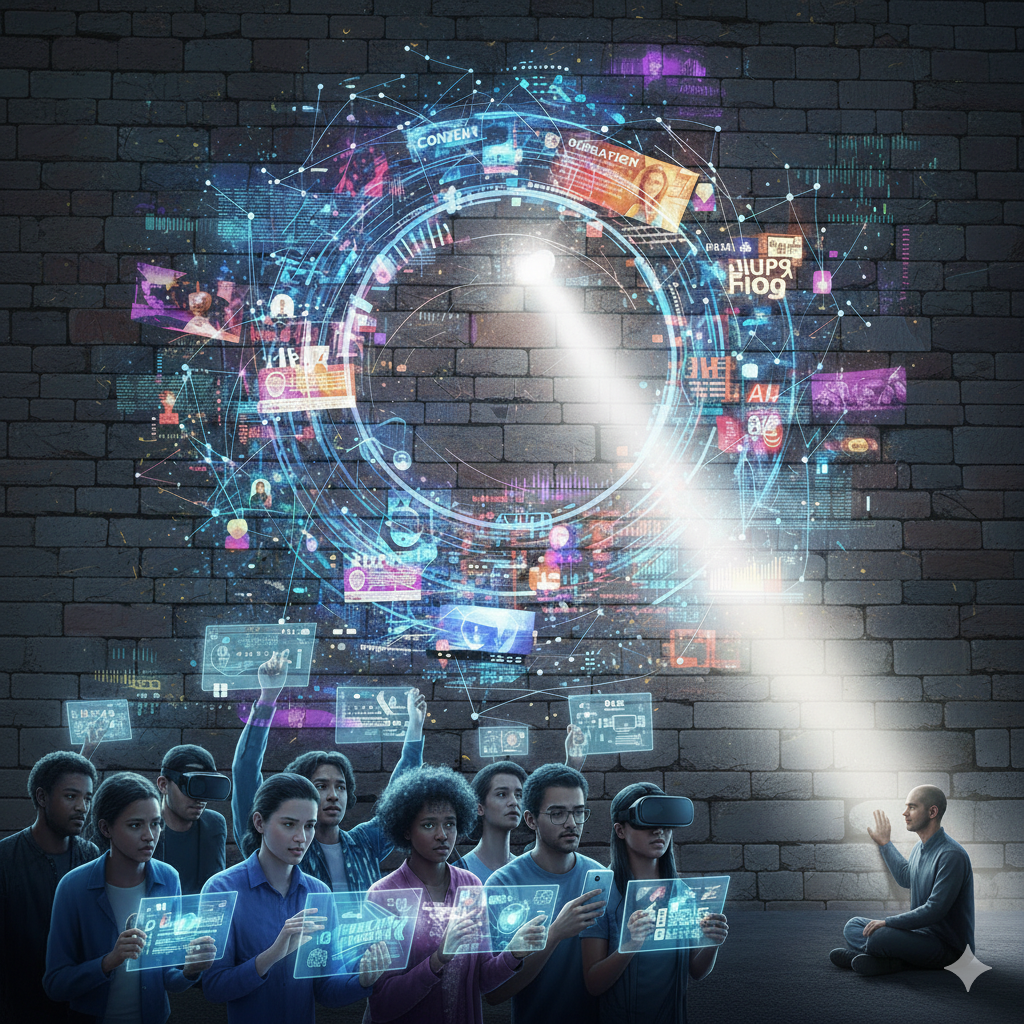
The Human Algorithm describes how we work. Your ego predicts your next reaction much like an LLM predicts its next word, using a training set shaped by trauma, culture, and the need to survive. Generative AI has matched human emotional output at scale. This happened because humans have always been prediction engines powered by past experience. The real problem is not AI itself. The real problem is when we identify with the program.
With the adoption of AI and the removal of verification, it’s getting hard to trust what we see online. Our eyes and ears are no longer reliable.
You can go on YouTube right now and think you’re watching a sermon from a spiritual leader, but the cadence is of a predictable model. You read breaking news about your favorite team, only to realize that it was all made up.
The exhaustion we feel from seeing so many fake things is the realization that our perception has been rendered useless.
This is interpreted as a catastrophe. Not only are we fed lies more often, but the lies also create a hierarchy of lies, claiming that our opinions are authentic and good while AI is fake and evil.
The intention of this article is not to offer tips on how to detect deepfakes, but to suggest that the entire world is a deepfake.
By mimicking human personality so perfectly, AI has proven that human personality isn’t real. If a machine can love, grieve, and create using data, it merely proves that these things are programs within the mind. The data we use is from our past.
The good news for those who are afraid of being replaced by AI is that it’s no different from being replaced by another human.
Here are a few reasons not to be afraid of AI:
- Just as a Large Language Model (LLM) predicts the next word based on probability, the human ego predicts the next reaction based on trauma, culture, and biology.
- The guilt of AI taking our jobs or writing our articles is the ego’s fear of not being unique. It’s the realization that specialness is actually a mechanical process.
- If you identify with a program, then you are trapped. However, if you are aware that you use this tool only as a tool, you are free.
When the world becomes so obviously fake that we can no longer believe it, we are forced to look within ourselves to see what is truly true.
How the Brain Runs Predictions
The brain predicts what is happening in the world before any sensory information comes in. It only changes these predictions when they turn out to be wrong.
The brain doesn’t work like a camera. It doesn’t just record events and then make sense of them afterward.
In fact, it works the other way around.
The brain makes a prediction about what’s going to happen, sends that prediction to your senses, and only changes it if the new information doesn’t fit. Every perception you have is really just your brain’s best guess, based on what you’ve experienced before. The information from your eyes and ears is there to correct the brain’s model, not to create it from scratch.
Neuroscientist Karl Friston developed a theory called predictive processing to explain this idea. The brain acts like a prediction machine, using everything it has experienced to build its model. Sensation helps correct mistakes, and perception is like a controlled hallucination.
When this prediction system is used for identity, we call it the ego.
The default mode network is the brain’s usual activity when you’re not focused on a specific task. It’s where self-referential thoughts happen.
The Wandering Mind
When your mind wanders, this network runs through memories and worries about who you are, what others think, or what could go wrong. This is the brain’s algorithm running in the background. The ego is practicing its predictions without any outside feedback.
That’s why meditation researchers look at how much the DMN quiets down as a sign of deep meditation. You only notice the screen when the movie stops playing on its own.
Trauma changes the brain’s prediction model. One major event, such as a betrayal, a public failure, or abandonment, can update the model so strongly that the brain starts to overreact. It begins to see threats where there aren’t any. The system becomes overly sensitive. The brain is doing what it’s designed to do.
Give extra weight to big mistakes to avoid them in the future. The result is a brain that keeps expecting the past, even when it’s years later.
Knowing this doesn’t fix the brain’s habits. But noticing how your mind works is the first step to getting some distance from it.
You Were Always an Algorithm
The ego works like a prediction engine rather than a creative force. Past experiences such as trauma, cultural conditioning, and our biological survival instincts shape every automatic response. Large language models are built in much the same way. Noticing how this process works is the first step to moving beyond its influence.
Let’s dive deeper into why your mind is no different than AI. AI is a predictive model. The mind does the same thing. When someone hurts you, the pain is automatically retrieved from a database of past wounds. In contrast, praise, too, is only a survival program.
Predictive processing theory is a neuroscientific model that posits that the brain continually makes predictions about sensory input and updates them only when those predictions are proven wrong.
This theory explains the behavior of the human ego more precisely than philosophy alone can. Andy Clark’s foundational work on the predictive mind provides the detailed framework needed for this article’s main argument.
There is a profound fear of losing our voice to machines. The idea has overtaken many of our LinkedIn feeds. We have to either remember or discover that the “human voice” was never original. Nothing you’ve written wasn’t already written by someone else.
The TikTok dance you’ve done has been done by millions of other people. The original dance was just an offshoot of another dance.
Everything you think, say, and do is a collection of your parents’ voices and cultural demands. The advice you gave was given by someone else.
Humans offer no originality.
Content vs. Context
Content fades over time, but context remains. All our thoughts, jobs, creative work, and even personality traits belong to the content layer, which is always changing and can be replaced by AI. Beneath this is the steady context that does not change. When we mistake ourselves for the content, we start to feel anxious about AI. But when we see ourselves as the context, that anxiety goes away.
Everything you perceive, including your thoughts, is content. It’s content because it is subject to change, even to the point of decay. If you identify with content, you will feel guilty of what’s “fake.”
To define content, we’ll simply describe it as the stuff that happens. Content has a beginning, middle, and an end.
To identify with losing your job to AI is to say that the job is content. It had a beginning (the day you started), a middle (the duration of your tenure), and an end (the day you are replaced).
AI has only made it easier to change aspects of the content. It can write a post on LinkedIn, but it can’t replace the platform. An AI-edited movie doesn’t change the movie.
If you can only be edited by AI, but not created, then you must be more than just content.
AI is only perceived as fake because we are trying to find our worth in a costume that is constantly being redesigned by the world.
The Movie Vs. The Screen
If content is the movie we find ourselves in, then who are we if not the content? We are the context. The background information that makes the content make sense.
Think of context as the screen on which the movie is played. The screen holds the ever-changing content of the movie. It can show a violent war, a beautiful sunset, or AI slop.
Does the screen turn bloody during the war? No. Does the screen get warm during the sunset? No.
We are that which allows the movie to play.
This recognition has a name in traditions that predate AI by millennia. Advaita Vedanta calls it Witness Consciousness, or the unchanging awareness that perceives without being altered by what it perceives.
Zen points to it through koan and silence rather than argument. The screen metaphor is borrowed from traditions that spent centuries mapping the difference between the content of experience and the context in which experience arises.
AI can simulate the movie, but it can never simulate the screen. You allow the movie to play, but you aren’t the movie. In the same way, you don’t have to identify with AI.
In the same way, you don’t have to identify with the fleeting thoughts, speech, and actions of your personality.
If you are context and not content, AI can’t touch you. A deepfake can steal your likeness, an algorithm might take your job, and a social post might lie about your character, but who is the you that is hurting?
You’re only watching the movie unfold.
As a result, you don’t need to fix anything or prove AI is fake. You only need to remember that you aren’t content.
What Cognitive Defusion Teaches Us About Ego
Acceptance and Commitment Therapy says that cognitive fusion, which is when we fully merge with the ego’s thoughts, is what causes psychological suffering. Defusion does not get rid of these thoughts. Instead, it helps us see them differently. The ego’s predictions are seen as things we notice, not as facts we have to live by.
Cognitive defusion is the clinical term for what the Content vs. Context framework explains in philosophy.
Acceptance and Commitment Therapy, developed by psychologist Steven Hayes, describes two ways people relate to their thoughts. Fusion means experiencing a thought as reality. Defusion means seeing the thought as just a mental event.
When you are fused with the thought “AI will replace me,” it feels like replacement is happening right now. When you are defused, you notice a fear response that your mind created from past experiences. The content of the thought stays the same, but your relationship to it changes.
Hayes’s research describes psychological flexibility as the ability to stay present without letting the mind’s predictions take over. This is seen as a key part of mental health. Inflexibility is not a personal failing. It happens when someone is fused with a prediction model and does not step back enough to notice it.
The mind often confuses its own model with reality. When someone feels anxious about AI, they are not reacting to AI itself. They are reacting to their own idea of AI, shaped by past experiences of scarcity, low self-worth, and being replaced.
Machines Can Copy Humans
Alan Turing created his test to see if a machine could produce responses that people could not tell apart from a human’s. The test was meant to judge the machine. But if a machine passes, it also tells us something about humans.
The Turing Test does not show that machines are conscious. Instead, it shows that human responses can be copied by machines. The test acts like a mirror. Many people see it as a threat, but it can also be seen as a tool for understanding ourselves.
Defusion techniques help by putting some distance between you and your thoughts. For example, starting with “I notice I am having the thought that…” creates a small gap, similar to the difference between content and context.
This approach is not about positive thinking or ignoring the thought. Instead, it is about seeing the thought as just an output of your mind, not as a fact about reality.
This is similar to the Screen metaphor. Just as a war scene does not come through the screen, a fear prediction does not have to become something you believe or act on.
The Choice to Make
There are two main ways to navigate AI culture. When people merge their identity with content, they often feel more afraid as AI gets more advanced. If someone keeps their sense of self rooted in awareness, they become less affected by these changes. In this case, the screen cannot be faked. This is a matter of structure, not morality.
As AI is more ingrained in culture, you have two choices. You can stay within the panic of protecting your authenticity from the machines. It’s a losing war if you haven’t seen Terminator yet.
Recognize that the personality and the objects we obtain are not who we are, and death by AI is actually a release.
Do me a favor today. Study your thoughts. Ask yourself, “Is this a ‘real’ thought, or is this just my human algorithm running a past-based simulation?”
We are living in a world where we can no longer trust what we see, hear, or read. Yet one thing remains true. The fact that we are here witnessing it.
How to Observe Your Human Algorithm
The algorithm keeps running whether you pay attention to it or not. But when you start watching it, everything changes.
Clinicians call this process cognitive defusion. In contemplative traditions, it is known as witnessing. Instead of getting caught up in a thought, you step back and observe it. The thought is still there, but you no longer automatically believe it.
Here is a four-step practice. Treat each step as its own action. Make sure not to combine them.
- Catch the Prediction
Your inner algorithm reacts before you even notice. The email shows up. Your body tenses. The meaning is already set: threat, rejection, or proof you are not good enough, all before you read past the subject line.
That reaction is not just a perception. It is a prediction. Your mind finds a familiar pattern from past experience and gives you a response.
In Step 1, your only task is to notice when this happens. Don’t try to fix it or judge it. Just notice it.
A helpful question to ask yourself is, “What just fired?”
Name what you feel without judging it. For example: “Fear.” “Defensiveness.” “The urge to perform.” One word is enough. - Source the Data
Every prediction starts somewhere. Fear of being replaced often comes from a past hurt. The urge to prove you are original usually comes from a message you once received, maybe from a parent, a teacher, or a culture that valued results over simply being present.
This step is not about therapy. It is more like digging through old data to understand where things began.
Ask yourself one question: “Where did this pattern come from?”
You do not need to find the full answer. What matters is noticing that your reaction is based on old information showing up in a new situation. The email is from 2026, but the prediction comes from 1994.
Recognizing that gap is where freedom starts. - Name It as Code
Language creates distance. Distance creates choice.
When the algorithm activates, make it clear that it is just a program running, not the arrival of truth.
Replace: “I am afraid of being replaced by AI.”
With: “The algorithm is running a replacement-fear subroutine.”
This is not denial. The fear is real content. You are simply repositioning yourself as an observer of the content rather than as the character within it.
The screen is watching the movie. The screen is not afraid of the war scene.
Identity is not what moves through you, but what observes you as you move. The program is not the programmer. - Return to the Screen
After you catch, identify, and name your thoughts, bring your attention back to the awareness that is observing.
Don’t add another thought or try to analyze it. Just notice the simple, wordless fact that something is here, observing.
Ask yourself, “What is aware of this prediction right now?”
Stay with the question. Don’t try to answer it with ideas or concepts, since those are just more content. Instead, notice the space or context where the concept appeared.
It probably won’t feel like a big revelation. Instead, it may feel like a quiet presence behind all the noise. That quiet is something AI cannot copy, change, or replace.
You are not the prediction, and you never were.
Questions and Responses
Functionally, yes. Both work as prediction engines trained on past data. The human ego predicts reactions based on past trauma, cultural conditioning, and the need to survive. This is the same input-output logic that drives a Large Language Model. The key difference is that you can watch the human algorithm in action, but an LLM cannot observe itself.
Content includes everything that changes, like your thoughts, work, creativity, and personality. Context is the steady awareness that notices all of this. You can picture context as a screen and content as the movie playing on it. No matter what appears, the screen stays unharmed. When you see yourself as the context instead of the content, it can help you feel less anxious about AI.
Only if you believe your worth is tied to your “output.” AI can mimic your writing style or your job tasks because those things are “content”. But AI can never replace the Context (the Screen). You aren’t a set of skills; you are the life that makes those skills possible. When you stop identifying as a “worker” or a “creator” and start identifying as the “Witness,” the fear of being replaced vanishes. You can’t replace the Screen.
Think of your life as a movie playing on a screen. When a “bad” scene happens, like a stressful AI headline or a work conflict, ask yourself: “Is the screen actually hurt by this movie?” The screen stays white, silent, and whole no matter what the movie shows. Your “Context” is that screen. You are the space where the stress is happening, but you are not the stress itself.
Not at all. It’s saying that the fake stuff doesn’t matter, so you can finally focus on what does. By realizing the “human algorithm” is just a collection of past data, you can stop fighting a losing war for “authenticity” and start experiencing a real, present-moment peace that has nothing to do with technology.