
All of us navigate the world through the lens of comparison and judgment. For one thing to be recognized, the other must be present.
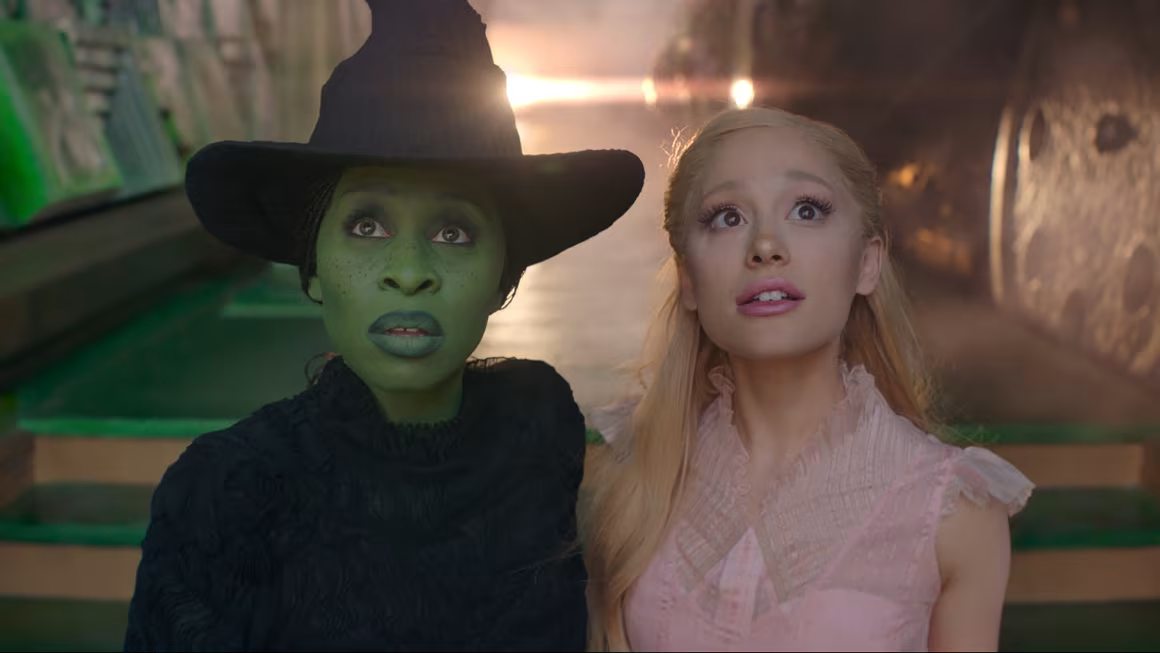
It’s the story of Wicked. For Glinda to be seen as good, there must be the opposite of evil, which was projected upon Elphaba.
We can’t define light without darkness, we don’t know up if there’s no down, and we can’t go right if we don’t know what’s left. In the same way, we can’t describe virtues like goodness, morality, and kindness without vices like evil, immorality, and cruelty.
We are made to believe that good and evil are two different forces fighting each other, but they are actually two sides of the same coin. When the mind points out something that is virtuous, it simultaneously points out that which is non-virtuous so that the virtuous thought is real.
If you see someone helping another person cross the street, we’d say that’s a virtuous act. Which also means that seeing a person struggling and not offering help is non-virtuous.
We also like to believe that good and evil play in a zero-sum game. Meaning, if we increase the amount of goodness in the world, then evil will diminish.
What if this isn’t true? The action of doing good requires evil for comparison. What if doing good only confirms the evil we seek to remove?
The Insecurities of Goodness
In the movie Wicked, the leadership in Oz tried to destroy evil by killing Elphaba, but in the process, they only practiced their own wickedness by spreading lies through propaganda, killing an innocent sister, and hiding the evil they were practicing against the magical animals of Oz. If the story were to continue, Oz would just find another villain to find as an adversary just to confirm their goodness.
It was also revealed that Glinda only became The Good because of insecurities.
In the same way, we try to identify with being good because we think that goodness is something we inherently lack. It might be that we believe we are inherently flawed, and that doing good means we are less bad.
We must do good because we are not good enough.
With this idea comes the need for external validation for our actions. If we do well, the praise from others lets us know that we are doing something right. Conversely, any blame directed at us shows that we aren’t working towards our ideal self. Any guilt and shame arising from our actions is a spark for “self-improvement.”
If not self-improvement, it’s the reason we need to tear down someone else so that we can be seen as more virtuous.
Attached to the Outcome
If we need the approval of others, seeking to be good is not an intrinsic intention, but a performance. It’s a performance because we only care about the results of our actions. We also take ownership of them if they meet our expectations. We are the ones who did well and should be treated accordingly.
The performance is captured to verify the performer’s identity. If the story is successful, it leads to the identity that I am good. If the story is a failure, it leads to the identity of a victim.
It might be better to say that if the outcome is good, we are good, but if the outcome is bad, we blame evil.
Good Actions as Redistribution of the Problem
At some point, I think we have to ask ourselves how much good we are doing, if any. How much impact do our good acts have? In many cases, it seems our good acts don’t solve any problems but merely confirm them. Any good action is a transaction between individuals that redistributes the problem.
By redistributed I mean that when someone does a good act, the problem remains constant. Yes, the issue is still there. It just shifts to another form.
This can be seen in the world of charity. If an act of charity is driven by the identity of being virtuous, on the surface, it seems beneficial. One person gains material resources, while the other gains the feeling of moral superiority or self-satisfaction.
However, the need for charity only highlights the bigger issue. The material gain from this transaction provides only temporary relief, yet the need for charity is intensified in the person making the donation. Giving to charity doesn’t solve the problem the cause faces, but only validates the need for charity.
This need for charity creates a separation between the donor and the person it’s to help. It’s the generous person and the needy. The act of donating to the “less fortunate” solidifies the notion of having and having not.
The needy believe that they need charity, and the performer is the one who’s generous enough to give it to them. In both cases, identities are only solidified, and nothing truly changes.
This is the game. There will be winners and losers. The emotions of joy and apathy switch between teams depending on whether they win or lose. At the end of the game, nothing is resolved. Just another game is played.
Removing the Moral Narrative
If a person can win one game and lose the next. This means that the idea of win and loss isn’t a universal truth but a temporary occurrence. The same thing can be said about good and evil. A person can do good one day and make a mistake the next.
The issue is that we tend to label permanent characteristics out of temporary actions.
This is good, or that is bad, gives identity to actions that come and go. These thoughts arise and persist, but eventually they go away. The error is believing that these judgments are an objective reality that requires further action or emotional involvement.
For example, we see a tweet that says a CEO of a large company has to step down. In our mind, we label this CEO as corrupt. We may not even know what action the person has taken. We just know that if it was bad, then the person is also bad. As a result, the sensation we feel from reading the tweet is anger.
It’s not to say these thoughts are wrong or that you should feel guilty for thinking them. These errors occur only when we identify with the thoughts and feelings.
When we feel anger and say I am angry, we are lying. At some point, that anger will subside, and what would you be then?
The same thing can be said about the CEO “being” corrupt. The CEO could have planted trees the day before. What would that make them?
Incapable of True Explanation
The moralistic narrative we cling to fuels our need to be “good.” The story requires a performer who takes accountability for all their actions. This performer also gets off on the highs of praise, but sulks in the lows of blame.
Something doesn’t happen because a person is “good” or “evil.” That’s a very simplistic way to describe numerous factors, including education, environment, biology, physics, and other things we can’t see with our eyes, in order to describe a circumstance.
The act of stealing isn’t a result of moral failure but of material scarcity, biological programming, and psychological conditioning.
There is no one to praise or blame.
There is no one to blame, thus no one to forgive. Even the virtue of forgiveness requires the perpetrator’s confirmation and validation. Forgiveness only validates that the pain was real. You can’t have one without the other.
Action Without Attachment
Action is a requirement of life. However, we don’t need to care about the results of the action. Very hard to do in a results-driven world.
Yet we can still work, play, and communicate without having to think about how good or bad we are. There will be times when compassion surfaces and help because we are compelled. There will also be times of aversion when we simply don’t like the people we are with.
Both of these are merely expressions of who we are, not who we are. To choose one is to negate and resist the other.
To act without attachment is also working without ownership. When we take ownership of our actions, there’s a debt that will always need to be paid.
The person who gives to the charity will always expect the impact of their donation. They didn’t give to give. They are seeking a transaction.
The same thing happens on the opposite end of the spectrum. If we take ownership of a mistake, it only means that we have to do something to make up for it.
We are perpetually trapped in this balance between doing good and making up for the mistakes we’ve made.
The only way to break out is to see the situation as it is and not identify with the next step we decide to take. In this way, there is no such thing as good or evil.
Questions and Responses
The desire arises from the belief that you are inherently flawed, or the feeling that you lack goodness. This seeking only solidifies the illusion of a deficient ‘Performer’ who needs to acquire virtue. The error is the identification with the seeking self, not the action itself.
Actions will continue to arise from the body and mind according to their nature. The focus is not on stopping the performance, but on removing the attachment to the outcome. When action happens without the personal claim of ownership or the need for validation, it is pure. The distinction between ‘good’ and ‘evil’ is merely a thought arising.
Charity, when driven by the ego’s desire for virtue, is a distributive transaction. It shifts the form of the problem (temporary material relief) but reinforces the separation between the ‘generous’ donor and the ‘needy’ recipient. The need for charity (the problem) is validated and intensified in the mind of the donor, confirming the false sense of ‘having’ and ‘having not.’
The concept of justice requires the false belief in a singular, accountable Performer who intentionally initiated a moral wrong. When the moralistic narrative is undercut, actions are seen as impersonal forces (biology, environment, causation) unfolding. Blame and forgiveness are transactions needed only by the separate self. The ultimate recognition is that there is no one to blame, and thus no need for the transaction of forgiveness.
It means recognizing that all moral labels such as corrupt, righteous, victim, hero are temporary thoughts. The error is believing these judgments are an objective reality that you must emotionally invest in.