
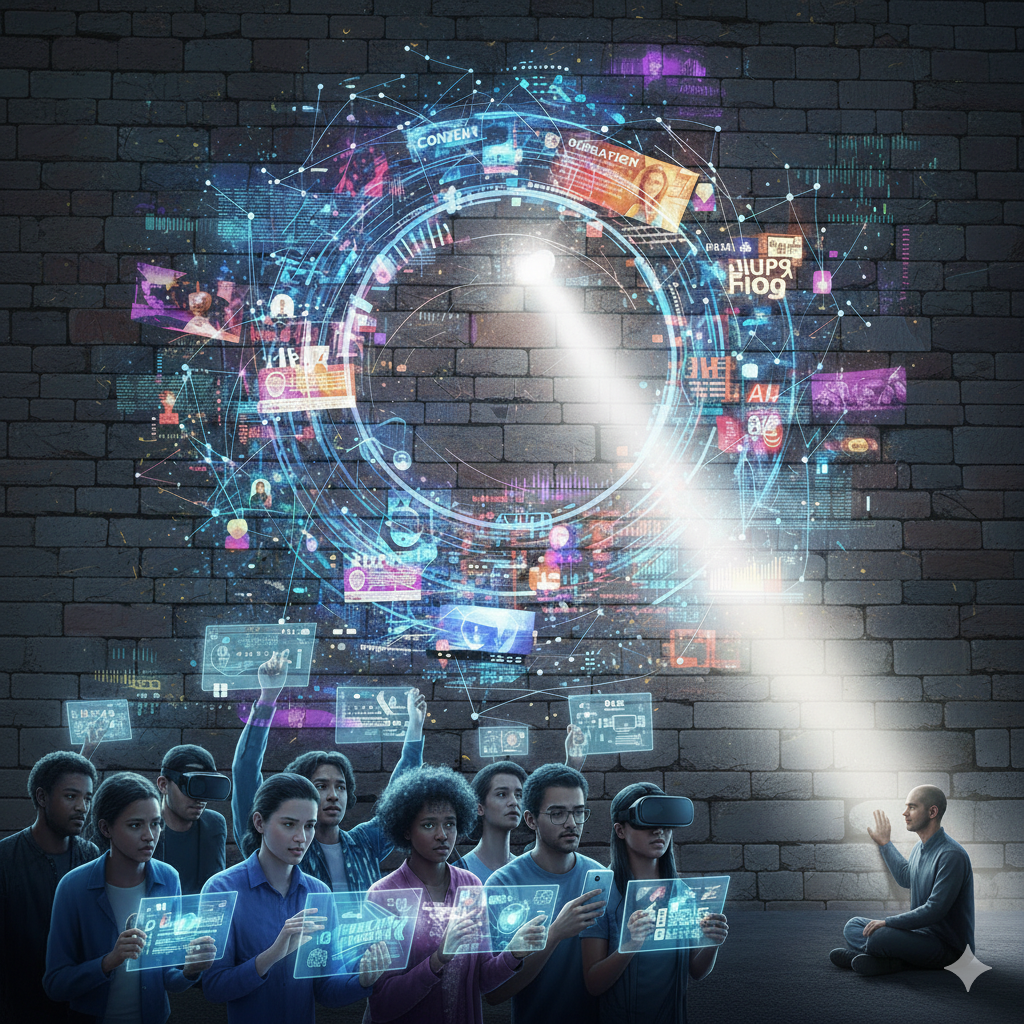
With the adoption of AI and the removal of verification, it’s getting hard to trust what we see online. Our eyes and ears are no longer reliable.
You can go on YouTube right now and think you’re watching a sermon from a spiritual leader, but the cadence is of a predictable model. You read breaking news about your favorite team, only to realize that it was all made up.
The exhaustion we feel from seeing so many fake things is the realization that our perception has been rendered useless.
This is interpreted as a catrasophe. Not only are we fed lies more often, but the lies also create a hierarchy of lies, claiming that our opinions are authentic and good while AI is fake and evil.
The intention of this article is not offer tips on how to detect deepfakes, but offer the idea that the entire world is a deepfake.
By mimicking human personality so perfectly, AI has proven that human personality isn’t real. If a machine can love, grieve, and create using data, it merely proves that these things are programs within the mind. The data we use is from our past.
The good news for those who are afraid of being replaced by AI is that it’s no different from being replaced by another human.
Here are a few reasons not to be afraid of AI:
- Just as a Large Language Model (LLM) predicts the next word based on probability, the human ego predicts the next reaction based on trauma, culture, and biology.
- The guilt of AI taking our jobs or writing our articles is the ego’s fear of not being unique. It’s the realization that specialness is actually a mechanical process.
- If you identify with a program, then you are trapped. However, if you are aware that you use this tool only as a tool, you are free.
When the world becomes so obviously fake that we can no longer believe in it, we are forced to look into ourselves to see what is actually true.
You Were Always an Algorithm
Let’s dive deeper into why your mind is no different than AI. AI is a predictive model. The mind does the same thing. When someone hurts you, the pain is automatically retrieved from a database of past wounds. In contrast, praise, too, is only a program for survival.
There is a profound fear of losing our voice to machines. The idea has overtaken many of our LinkedIn feeds. We have to either remember or discover that the “human voice” was never original. Nothing you’ve written wasn’t already written by someone else.
The TikTok dance you’ve done has been done by millions of other people. The original dance was just an offshoot of another dance.
Everything you think, say, and do is a collection of your parents’ voices and cultural demands. The advice you gave was given by someone else.
Humans offer no originality.
Content vs. Context
Everything you perceive, including your thoughts, is content. It’s content because it is subject to change, even to the point of decay. If you identify with content, you will feel guilty of what’s “fake.”
To define content, we’ll simply describe it as the stuff that happens. Content has a beginning, middle, and an end.
To identify with losing your job to AI is to say that the job is content. It had a beginning (the day you started), a middle (the duration of your tenure), and an end (the day you are replaced).
AI has only made it easier to change aspects of the content. It can write a post on LinkedIn, but it can’t replace the platform. A movie edited with AI doesn’t change the movie.
If you can only be edited by AI, but not created, then you must be more than just content.
AI is only perceived as fake because we are trying to find our worth in a costume that is constantly being redesigned by the world.
If content is the movie we find ourselves in, then who are we if not the content? We are the context. The background information that makes the content make sense.
Think of context as the screen on which the movie is played. The screen holds the ever-changing content of the movie. It can show a violent war, a beautiful sunset, or AI slop.
Does the screen turn bloody during the war? No. Does the screen get warm during the sunset? No. Does the screen appear “fake” when a deepfake is playing on it? No.
We are that which allows the movie to play. AI can simulate the movie, but it can never simulate the screen. You allow the movie to play, but you aren’t the movie. In the same way, you don’t have to identify with AI.
In the same way, you don’t have to identify with the fleeting thoughts, speech, and actions of your personality.
If you are context and not content, AI can’t touch you. A deepfake can steal your likeness, an algorithm might take your job, and a social post might lie about your character, but who is the you that is hurting?
You’re only watching the movie unfold.
As a result, you don’t need to fix anything or prove AI is fake. You only need to remember that you aren’t content.
The Choice to Make
As AI is more ingrained in culture, you have two choices. You can stay within the panic of protecting your authenticity from the machines. It’s a losing war if you haven’t seen Terminator yet.
Recognize that the personality and the objects we obtain are not who we are, and death by AI is actually a release.
Do me a favor today. Study your thoughts. Ask yourself, “Is this a ‘real’ thought, or is this just my human algorithm running a past-based simulation?”
We are living in a world where we can no longer trust what we see, hear, or read. Yet one thing remains true. The fact that we are here witnessing it.
Questions and Responses
It feels like a catastrophe because we were taught to trust our eyes and ears. But here is a different way to look at it: the “fake” nature of the internet is actually a gift. It is forcing us to stop looking for truth in videos, articles, or images. If everything outside of you can be faked, you are finally pushed to look at the only thing that can’t be simulated: the silent Awareness that is watching the screen right now.
It means your habits, your typical reactions, and the way you speak function like a program based on your past. Most of us have been “auto-piloting” for years. Recognizing this doesn’t make you a machine; it actually sets you free. When you realize your ego is just “software,” you stop taking its fears and dramas so seriously. You aren’t the software; you’re the one running it.
Only if you believe your worth is tied to your “output.” AI can mimic your writing style or your job tasks because those things are “content”. But AI can never replace the Context (the Screen). You aren’t a set of skills; you are the life that makes those skills possible. When you stop identifying as a “worker” or a “creator” and start identifying as the “Witness,” the fear of being replaced vanishes. You can’t replace the Screen.
Think of your life as a movie playing on a screen. When a “bad” scene happens, like a stressful AI headline or a work conflict, ask yourself: “Is the screen actually hurt by this movie?” The screen stays white, silent, and whole no matter what the movie shows. Your “Context” is that screen. You are the space where the stress is happening, but you are not the stress itself.
Not at all. It’s saying that the fake stuff doesn’t matter, so you can finally focus on what does. By realizing the “human algorithm” is just a collection of past data, you can stop fighting a losing war for “authenticity” and start experiencing a real, present-moment peace that has nothing to do with technology.